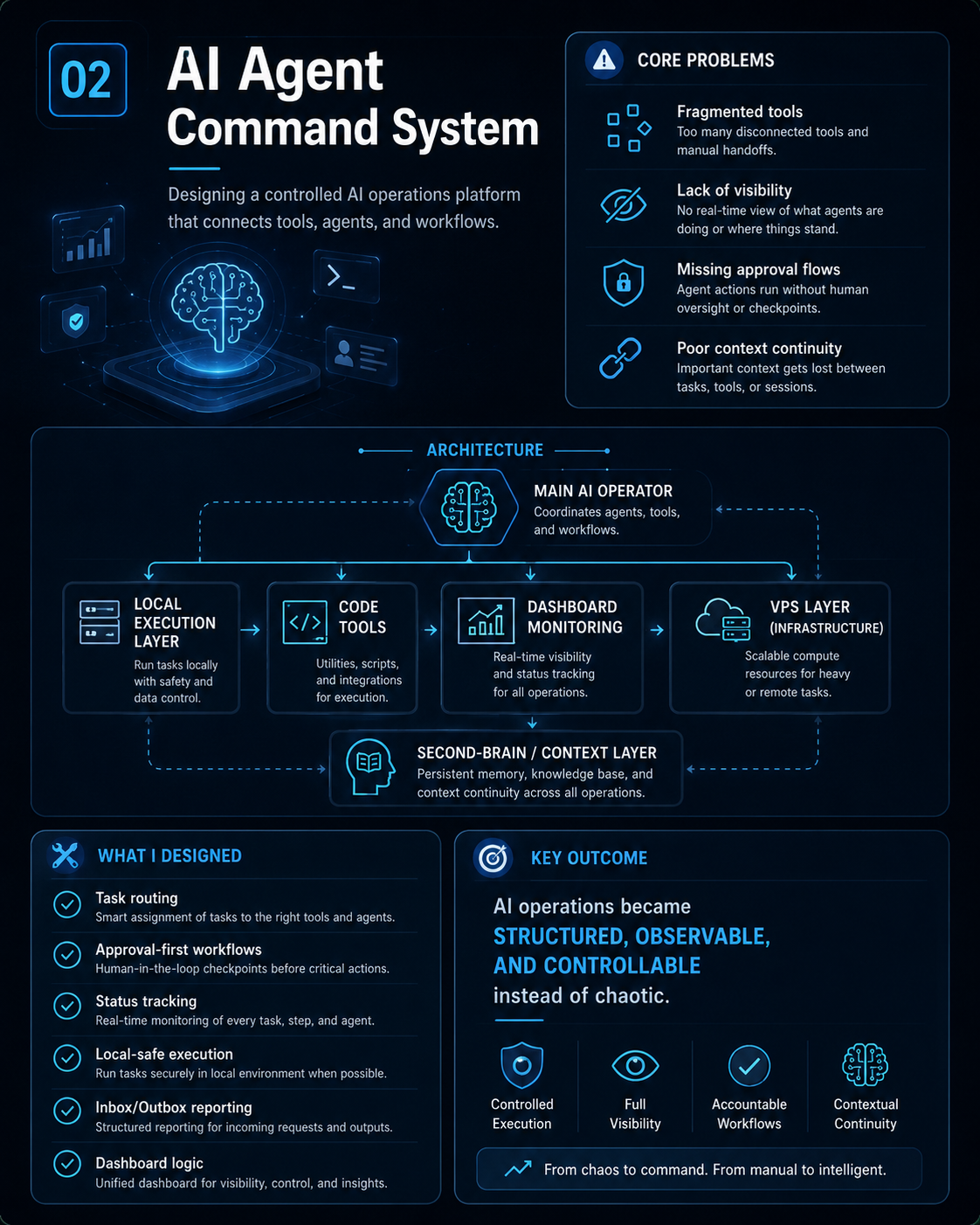
Full case study
Project Overview
This project was created to solve a growing operational problem: using multiple AI tools manually becomes chaotic very quickly.
There were several tools involved — a conversational AI agent, local Windows execution, coding tools, a VPS, local models, automation workflows and dashboards. Each tool was useful on its own, but the real value would come from connecting them into one controlled system.
The goal was to design an AI command system where the user communicates with one main agent, while specialized tools and agents execute tasks under supervision.
Main Problems
The first problem was fragmentation. Different AI tools were being used for different tasks: one tool for coding, one for local execution, one for server-side control, one for context and memory, one for dashboard visibility and one for future automation workflows.
Without a central structure, the human had to manually copy information, monitor progress, approve actions and remember what each system was doing.
The second problem was safety. AI agents can be powerful, but they should not have unlimited freedom to modify production systems, access sensitive areas or run risky commands without approval.
The third problem was visibility. If an agent starts a task, the user needs to know what is currently running, which agent owns the task, what is waiting for approval, what failed, what was completed and where the report is stored.
The fourth problem was context. AI agents often lose track of long-term goals. The system needed a way to preserve project context and keep tasks connected to the larger business objective.
Solution
The solution was to design a layered AI architecture.
One primary AI agent acts as the decision layer. Specialized tools execute only after tasks are structured. Sensitive actions require approval. All tasks and reports are logged. A dashboard shows the status of the system. Local execution happens on the user’s machine, not through exposed public systems. The VPS is used for lightweight monitoring and communication, not heavy execution.
The system was designed around a main AI operator, local execution layer, code tools, dashboard, VPS layer and second-brain/context layer.
Specific Work Done
The project included designing the agent hierarchy, defining the role of each agent/tool, creating a local AI workstation folder structure, planning task inbox and report outbox logic, creating a dashboard concept for monitoring, designing approval-first workflows, building a local runner concept, defining safe communication between local machine and VPS, separating execution, memory, routing and reporting responsibilities and preparing the system for future integrations with code tools and automation tools.
The dashboard concept included active agents, current tasks, approval center, worker status, activity logs, project status, reports and system health.
Key Strategic Idea
The strongest part of the system was not just automation. It was control.
Many AI automation setups focus only on how to make the AI do things. This system focused on how to make AI useful without losing control.
The principle was: AI should not replace the operator. AI should multiply the operator’s ability to manage tasks, context and execution.
Resulting Value
The system created a foundation for a practical AI operations platform. It can be presented as an internal command center for agencies, technical teams or business owners who want AI agents to help with execution while keeping human approval and visibility.
This case is especially relevant for potential AI clients because it shows thinking beyond simple chatbots. It demonstrates architecture, safety, workflow design and business process understanding.
---