Full case study
Project Overview
The project was a competitive mobile basketball game built around fast matches, player progression, team identity and skill-based gameplay. The business goal was not simply to launch a game, but to create a marketing and analytics system that could support user acquisition, retention analysis and future monetization decisions.
From the beginning, the key challenge was clear: installs alone would not be enough.
For a mobile game, the real business value comes from knowing what happens after the install. A campaign may generate cheap users, but if those users do not complete onboarding, play their first match, return the next day or engage with monetization systems, the traffic has no real value.
That is why the marketing strategy was built around measurement first.
Main Problems
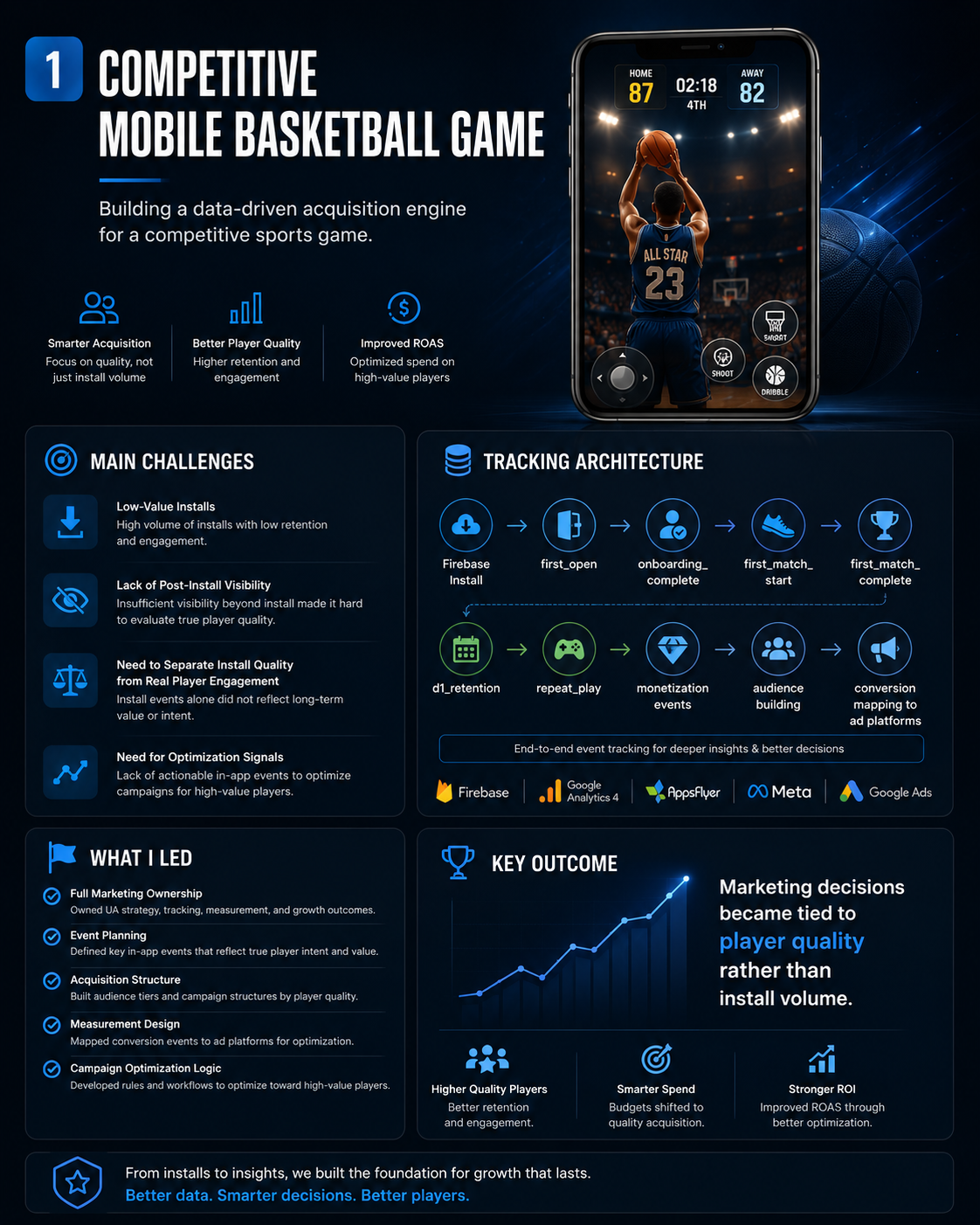
The biggest challenge was that the game needed a complete tracking logic before serious advertising could scale. Without structured Firebase events, the team would only see surface-level numbers such as installs and clicks, but not player quality.
The second challenge was that mobile game campaigns need optimization signals. Google Ads and other acquisition channels perform better when they receive meaningful in-app events, not just install data. If the system only tracks installs, the algorithm may optimize for low-cost users instead of high-quality players.
Another issue was that the player journey had multiple important moments: first open, onboarding, first match, repeat session, engagement depth, possible purchase behavior and retention. These needed to be translated into measurable events.
The marketing also had to communicate the game clearly. It was not just another basketball game; it needed to be positioned around competition, progression, sports identity and the feeling of building your own basketball presence.
Solution
The first step was to define the full player journey from the perspective of marketing and analytics.
The Firebase tracking structure was planned around key user actions such as first app open, tutorial or onboarding progress, first match started, first match completed, return sessions, engagement milestones, player progression, store or monetization interactions, potential purchase-related behavior and retention-focused events.
The idea was to create a tracking setup where every major stage of the player lifecycle could be measured.
Instead of treating all users equally, the setup allowed the business to separate users who only installed the game from users who opened it, completed onboarding, played their first match, returned, showed stronger engagement signals or demonstrated potential monetization behavior.
This made the marketing system more intelligent. Campaigns could later be optimized not only for installs, but for actions that actually indicate player quality.
Firebase & Marketing Tracking Logic
Firebase was used as the core analytics layer because it connects naturally with app behavior, audiences and Google Ads optimization.
The tracking concept was to define the important in-game actions, turn those actions into Firebase events, mark the most important events as conversions, connect the Firebase data with advertising platforms, use the data to evaluate campaign quality, build audiences based on real behavior and optimize campaigns toward better users, not just cheaper installs.
This setup made it possible to think in terms of user quality. One campaign might generate lower-cost installs but weak engagement. Another campaign might generate fewer installs but more users who play matches and return. Without Firebase events, those two campaigns may look similar. With proper tracking, the difference becomes visible.
Marketing Ownership
My role was not limited to setting up ads. I was responsible for the broader marketing logic: defining the user acquisition strategy, planning the event tracking structure, connecting marketing goals with in-game behavior, thinking through campaign optimization signals, preparing the game for scalable paid acquisition, structuring the communication around competitive gameplay and creating the foundation for retention and monetization analysis.
The main principle was that the game should not spend money blindly. Every paid campaign had to feed data back into the business.
Resulting Value
The project received a performance marketing foundation suitable for a real mobile game launch. The most important outcome was not just that the game could run ads, but that it could understand the difference between low-quality installs and valuable users.
This created a system where future decisions could be based on behavior, not assumptions.
---