Full case study
Project Overview
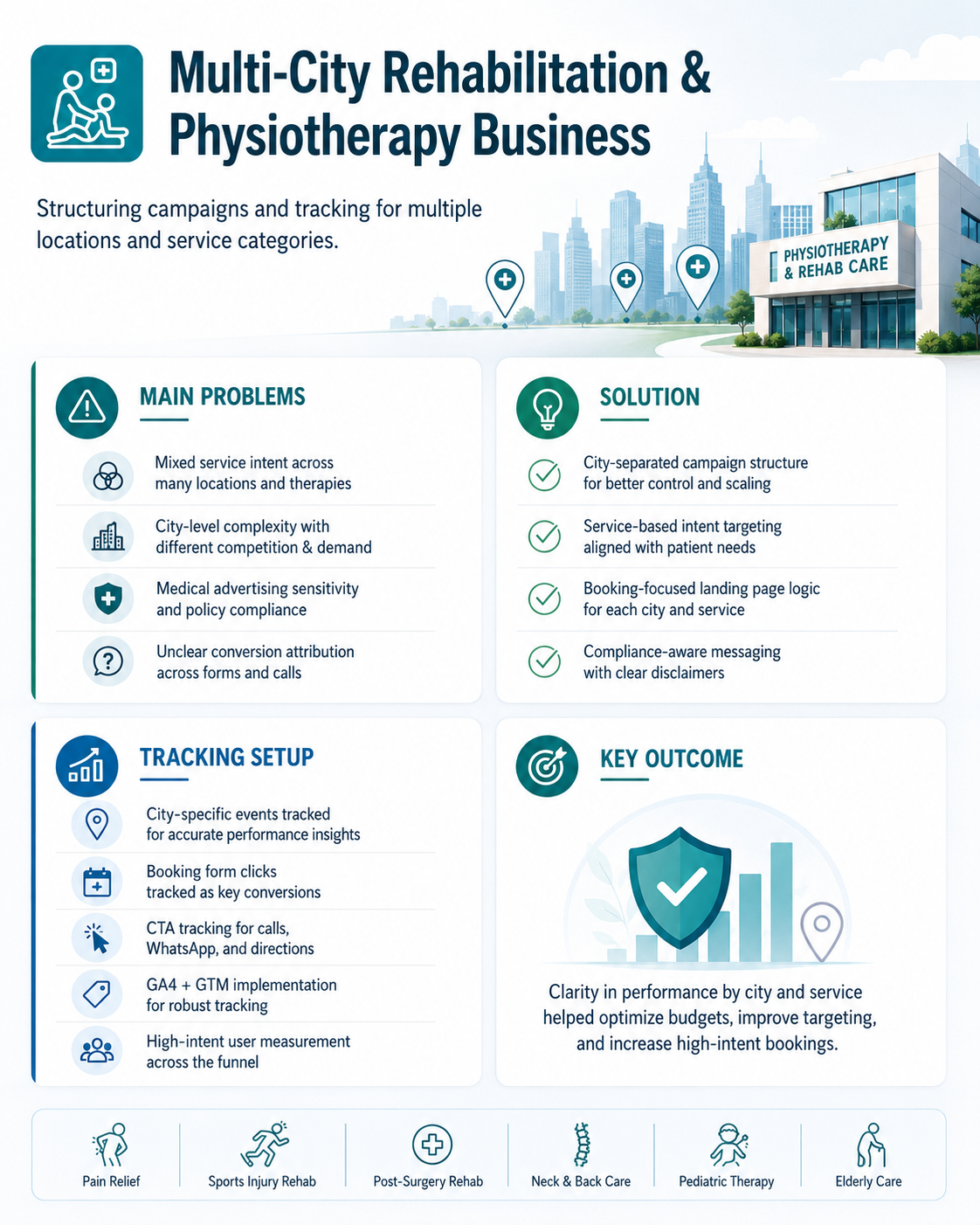
The business operated across multiple locations and offered different service categories: rehabilitation, home visits, massage, equipment-based procedures, diagnostic services and cosmetic/body procedures.
The marketing challenge was that the business did not have one simple offer. It had multiple services, different cities and different user intents. A single generic campaign would mix everything together and make optimization difficult.
Main Problems
The first problem was campaign structure. Different cities had different services and different landing pages. If all services were mixed into one campaign, it would be impossible to know what was actually working.
The second problem was intent separation. Someone searching for rehabilitation after an injury is not the same as someone searching for massage, home rehabilitation or a cosmetic body procedure. These users need different messages and different landing pages.
The third problem was tracking. The business needed to know which city and which service category generated real user actions. Generic conversions would not be enough.
The fourth problem was compliance. Healthcare advertising requires careful language. Claims must be professional, realistic and aligned with platform policies.
The fifth problem was the booking flow. The campaigns were sending traffic to specific booking or service pages, so every URL had to be reviewed. If traffic goes to the wrong page, campaign performance suffers even if the ads are good.
Solution
The marketing structure was rebuilt around three core principles: separate campaigns by city, separate services by intent and track meaningful booking actions, not just page views.
The campaign structure was planned as one campaign for the first city with all relevant rehabilitation, diagnostic and home-visit services; one campaign for the second city with rehabilitation, massage and home rehabilitation; one separate campaign for the cosmetic/body procedure offer; asset groups organized by service category and keyword intent; no unnecessary extensions where the user experience did not require them; and business identity aligned with the website.
Tracking & Analytics Work
The tracking approach focused on making the campaigns measurable by real action.
The setup included GA4 event review, GTM planning, conversion events for booking-related clicks, city-specific tracking logic, CTA tracking for different locations, review of final URLs used in ads, checking whether campaign traffic reached the correct service pages and separating traffic and conversion logic by user intent.
The idea was to avoid a common problem in local service marketing: all leads being treated the same.
A booking click for a high-value service in one city is not the same as a general page visit from another location. The tracking needed to reflect that.
Ad Platform Issues Solved
During the campaign setup, several practical issues had to be handled: Google Ads Editor import problems, campaigns appearing differently after posting, asset groups and search themes requiring restructuring, campaigns showing limited eligibility, confusion around whether campaigns were actually uploaded, platform limitations around Merchant Center availability in Bulgaria, medical ad restrictions and language limitations and separation of service pages and booking pages.
The solution was to clean the campaign structure and rebuild it in a way that matched the business goals more directly.
Resulting Value
The business received a clearer acquisition system where each location and service category could be understood separately.
Instead of asking “Are the ads working?”, the business could start asking better questions: which city produces stronger demand, which service category generates more booking intent, which landing pages deserve more traffic, which campaign should receive more budget and where the funnel breaks.
This is the type of marketing structure that allows real optimization.
---